We’ve all heard by now that corn-based ethanol has turned out to be a bad idea.
- Corn is energy intensive to grow, gobbling up fossil-fuels at every stage of production, from transporting seeds to fertilizing the fields (with petrochemical fertilizers) to final harvest.
- Corn is also a spectacularly water-intensive crop.
- The ethanol production stage consumes more fossil fuels and water.
- Once it finally reaches your gas tank, ethanol burns around 30% less efficiently than gasoline (meaning your per-mile cost is actually 30% more than you think it is).
- Estimates of how much actual energy we get out of the process range from barely breaking even to around 20 percent more than the input energy.
- And of course, every step of the process spews CO2 into the atmosphere.
It’s been almost a year since The New York Times editorialized on the subject:
The economics of corn ethanol have never made much sense. Rather than importing cheap Brazilian ethanol made from sugar cane, the United States slaps a tariff of 54 cents a gallon on ethanol from Brazil. Then the government provides a tax break of 51 cents a gallon to American ethanol producers — on top of the generous subsidies that corn growers already receive under the farm program.
And unlike our inefficient corn-based ethanol, that Brazilian product actually yields 370% of the energy put into it.
So, why are we doing this? What possible calculus could convince us to even consider corn ethanol?
Corn is big business – and big agribusiness hires the best lobbyists.
Here, the return on investment is spectacular: plant a few tens of millions of dollars in seed money in the form of campaign contributions to senators and members of Congress, and reap billions of dollars in federal farm subsidies.
And for agribusiness, corn is king.
Cheap corn – kept cheap through an insanely generous subsidy system – has distorted nearly every facet of American life:
- Energy: Subsidies fueled the ethanol boom
- Meat: Subsidies push cheap corn into the feed of cattle, encouraging huge feedlot factory farms, with all the problems they entail
- Health: Twenty thousand people in the US are infected with E coli 157 bacteria every year, and 200 die of it; this strain of E coli developed in corn-fed cows and is spread by bovine waste
- Food: Subsidies (and tariffs on sugar) push high-fructose corn syrup into just about everything you eat, contributing to the US obesity epidemic
- Immigration: Subsidized US corn is dumped on the Mexican market, driving small farmers out of business and off the land, driving them to seek jobs in the US.
Yes, even the immigration problem is fueled by cheap corn.
Simon Donner of the University of British Columbia has put together a great graphic on what happens to all the heavily-subsidized corn the US produces every year (via Ezra Klein).
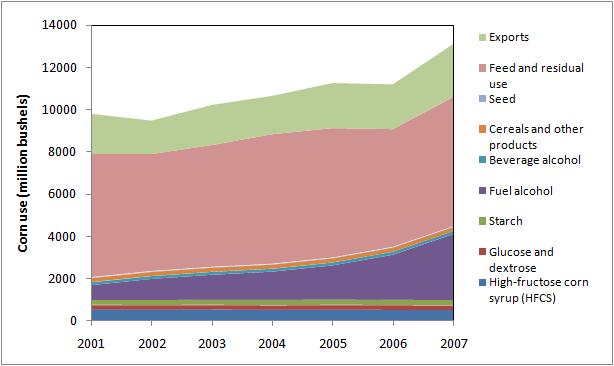
As you can see, it’s not about Corn Flakes. The stuff you eat (“Cereals and other products”) barely shows. Keep that in mind as you ponder our farm policy, and the farm subsidy choices being made in Washington.
The graph… shows the end use of US corn over the past six years (all data that follows is from the Foreign Agriculture Service and the Economic Research Service of the USDA). The big pink block in the middle is domestic feed use (~60%, down to 47% last year). The top category is exports, most of which is also used as feed (19%). The dreaded high-fructose corn syrup has been around 7% (5% last year) of the corn crop, glucose / dextrose around 2-3%, beverage alcohol (yep, there’s corn in that Bud Light) around 1-2%. Cereals and other foods? 2%.
The one area of growth (in blue) is fuel alcohol, or ethanol. Last year, 24% of all US corn production (29% of non-export corn) was used for ethanol.
We’ve known for years now that ethanol makes no economic sense, but we’re dumping a quarter of our corn crop into it.
Ethanol is just the latest in a string of boondoggles.
Next, we’ll see how King Corn has left thousands of Americans living next to lakes of poo, driven tens of thousands of farmers off the land, and left millions of us with clogged arteries from questionable beef.
Great article!
The boondoggle is even much worse…
Peasants around the world can’t afford US corn anymore, so they’re burning rainforests to plant corn so they can eat and it’s accelerating GLOBAL WARMING! See “The Ethanol Lie” on youtube.com or go to http://www.ethanol-lie.com
Another thumbs up for another blogger, altering the eco and keeping up the good fight. Great Article.
LONG LIVE EMPEROR OBAMA!
Obama is a racial-minority individual and does not like racism:
I know it may be hard to believe, but there is absolutely no doubt about it: Ronald Wilson Reagan committed horrible, racist, hate crimes during his presidency.
A lot of people know about the infamy surrounding Ronald Wilson Reagan's former existence.
And a lot of people will know about Reagan's infamy–even until the end of human existence: they'll find out.
Numbers 32:23: “Be sure your sin will find you out.”
Respectfully Submitted by Andrew Yu-Jen Wang, J.D. Candidate
B.S., With the Highest Level of Academic Honors at Graduation, 1996
Messiah College, Grantham, PA
Lower Merion High School, Ardmore, PA, 1993
(I can type 90 words per minute, and there are thousands of copies on the Internet indicating the content of this post. And there are at least hundreds of copies in very many countries around the world.)
_________________
“If only it were possible to ban invention that bottled up memories so they never faded and they never got stale.” Off the top of my head—it came from my Lower Merion High School yearbook.
Even American University studies show Bio-diesel by Algae to be a better deal than ethanol. SEE:
The University of New Hampshire is exploring ways of forced production of algae for biodiesel that is yielding 10,000 gallons per acre and uses salty water. Their calculations show that a tiny area of the Sonoran desert in New Mexico (about 9%) is enough area to produce all of the transportation fuel in the U.S. using their production techniques. Already, one company is experimenting with algae production stations at a power plant to capture the CO2 from the exhaust and use it to make algae for biodiesel” http://www.itsgood4.us/biodiesel.htm
Defending the Status Quo, Most Americans refuse to acknowledge the Euro-Diesels superiority over the Yankee-Doodle low compression spark ignition system, The truth as I see it, We can switch to Algae based bio-diesel, and the new Euro- Turbo-bio-diesels and in that single move! in one goddam move! cut our fuel consumption by 40% just by the fact that the higher compression Euro Diesel is for a fact a 40% more efficient engine – and get off of at least that much foreign oil! Next, we need the super, high speed, intercity train system, not the old 19th century British replica system we suffer with now! A new, German of Japanese, or even Chinese Bullet-train system, complete with computer control! Such a system will retire the now high fuel consuming air traffic we use, and get rid if imported oil once and for all, then, paying down the deficit with super-deflated dollars will be easier than carrying the wheel-barrows full of them to the grocery store for food! A side item of great benefit will be the eradication of heavy trucks on the highways, the SUV's will be gone with GM and we can enjoy fast, three wheeled mega-ultra-economical carbon fiber bodied commuter cars, two per family not unreasonable, and get things done a lot simpler than in the days of the sheetmetal and poured piston engine block grease pit technology times – and electric motors only have three, very rebuildable moving parts, and recyclable Li batteries! Better times are possible for America, we are only one swift dose of laxative away from them!