Where’s the beef?
It’s not down on the farm these days, alas. The healthy, natural beef of years gone by is almost extinct. It has been driven out by cheap beef, raised on gigantic feedlots, fattened on corn. The problem is: corn isn’t healthy for cows, and raising beef this way ultimately isn’t healthy for us either. Here are some things to watch out for and ways to be more healthy when it comes to your beef-related choices.
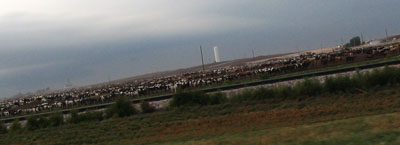
If you ask children, “What do cows eat?”, they’ll tell you: “Cows eat grass!” Not corn – grass. Kids are smart; smarter, it seems, than the barons of agribusiness, who haven’t figured that part out yet.
Why do farmers feed cows on corn? First, because it’s cheap, thanks to massive federal subsidies. Second, because starchy corn forces cows to fatten up faster. Cattle evolved a complex digestive system to derive nutrition from rangeland grasses; feed them on corn and their digestion goes haywire, causing flatulence, acid stomach, and massive weight gain.
This isn’t healthy for cows: with their immune systems damaged, the cows get sick – an amazing array of illnesses, ranging from liver abscesses and infections to dust-inspired respiratory disease. So agribusiness loads them up with antibiotics to keep them alive long enough to get them to the slaughterhouse – and your plates.
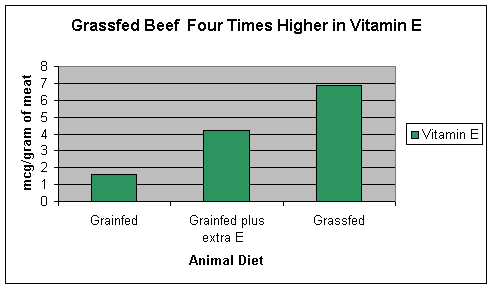
This also isn’t healthy for people: this beef ends up lower in nutrients (everything from vitamin A to vitamin E) and higher in fat – the bad kind, cholesterol-boosting fat. And the rampant use of antibiotics in crowded conditions has led to the rise of a new breed of super-bugs that are sickening thousands and possibly millions.
You heard about the spinach infected with E. coli 157? There’s no way to prove anything, but it’s likely the infection came from animal waste. Agribusiness likes to say “It could come from over-flying birds or foxes running through the fields,” but the most probable cause is the lakes of animal waste on nearby cattle farms. Remember the acid indigestion the cows get from corn? E. coli 157 doesn’t live in the guts of normal, grass-fed cattle, but it thrives in the acid environment of corn-fed cows.
This is a growing problem – 199 people got sick during the spinach outbreak and three died, but that’s a drop in the bucket compared to the 20,000 people a year who are infected with E. coli 157 ,and 200 who die. It’s mostly the very young and the very old who are vulnerable; infection from E. coli 157 is the biggest cause of kidney failure in children.
The biggest irony: none of this makes any economic sense at all! Nobody would bother feeding corn to cattle if we weren’t all paying billions of dollars in subsidies to make corn cheap. And consider this: Cornell’s David Pimentel points out that growing that corn takes vast amounts of petroleum-based chemical fertilizer.
Because of this dependence on petroleum, Pimentel says, a typical steer will in effect consume 284 gallons of oil in his lifetime. Comments Michael Pollan,
“We have succeeded in industrializing the beef calf, transforming what was once a solar-powered ruminant into the very last thing we need: another fossil-fuel machine.”
Giant agriculture distorts everything. In real agriculture, poop is fertilizer. But we use petroleum products to fertilize the corn, send the corn to giant cattle operations, which churn out massive lagoons of dammed-up poop. It should go back to fertilizer, but it’s such an antibiotic and chemical-laced concoction that is nothing but a toxic waste-product.
So now you know more of the facts, but what can you do to improve your diet and make a global difference as well? Vegetarians would like you to cut out beef completely, but that’s not really necessary.
- Cut back on beef (and meat). One or two days a week without meat is the equivalent of switching from a gas-powered sedan to a hybrid. (It’ll also save you money, and is good for your heart).
- When you do eat beef, go for free-range or grass-fed. Organic is best – it’s more expensive, true, but remember, you just cut out a day or two of beef, so you can afford to eat better. Better for you, and better the planet – there’s some evidence that grass-fed cows actually helps sequester carbon in the soil as they graze.
- Watch your dairy intake, too. Most big dairy producers are as bad as the beef feedlots. Cut back on dairy, or switch to organic for lower impact.
- Watch out for corn in your veggie products! Once you start reading ingredient labels, you’ll be shocked and appalled to see how American processed food is loaded up with corn and corn derivatives (loaded with dairy derivatives, too!). It is a good idea to cut back on processed foods anyway, as they are loaded with all kinds of weird chemicals and additives (many of which are manufactured in bulk in China with minimal safety standards).
Just to update: Michael Pollen sums it up best:
<blockquote cite=”In fact there is nothing inherently efficient or economical about raising vast cities of animals in confinement. Three struts, each put into place by federal policy, support the modern CAFO, and the most important of these — the ability to buy grain for less than it costs to grow it — has just been kicked away. The second strut is F.D.A. approval for the routine use of antibiotics in feed, without which the animals in these places could not survive their crowded, filthy and miserable existence. And the third is that the government does not require CAFOs to treat their wastes as it would require human cities of comparable size to do. The F.D.A. should ban the routine use of antibiotics in livestock feed on public-health grounds, now that we have evidence that the practice is leading to the evolution of drug-resistant bacterial diseases and to outbreaks of E. coli and salmonella poisoning. CAFOs should also be regulated like the factories they are, required to clean up their waste like any other industry or municipality.
It will be argued that moving animals off feedlots and back onto farms will raise the price of meat. It probably will — as it should. You will need to make the case that paying the real cost of meat, and therefore eating less of it, is a good thing for our health, for the environment, for our dwindling reserves of fresh water and for the welfare of the animals. Meat and milk production represent the food industry’s greatest burden on the environment; a recent U.N. study estimated that the world’s livestock alone account for 18 percent of all greenhouse gases, more than all forms of transportation combined. (According to one study, a pound of feedlot beef also takes 5,000 gallons of water to produce.) And while animals living on farms will still emit their share of greenhouse gases, grazing them on grass and returning their waste to the soil will substantially offset their carbon hoof prints, as will getting ruminant animals off grain. A bushel of grain takes approximately a half gallon of oil to produce; grass can be grown with little more than sunshine.”
Corn is the only thing the dumb-fucks in the corn belt can do good! Re- educate them into growing a more diversified sorts of things and stop corn subsidies too! Corn is just too good, too cheap and too useful! America runs on corn and its products! The Koreans won't eat our meat, and riot in the streets to stop it from being sold in the stores! Why? What do they know that we do not know? We also factory farm pigs and let all that methane (pigshit) go down our rivers, growing huge oriental catfish we are too good to eat – the fish should be caught, canned and sold to Asia! The pigshit should be fermented for the methane and sold as fuel! – same with cowshit! One day when the Arabs find out we print up the money we pay them for oil, and cut us off, we will all be sorry for wasting all that shit!, and we will be walking a lot more too! Right now though, we slide our fat asses into our Vettes and blast off down the highway and we don't have shit to worry about!
Amen to Michael Pollen!
I was cleaning out my freezer and found a package of beef that expired two weeks ago. It wasn´t frozen when I bought it, I put it in the freezer and then forgot about it. Is the expiration date only for when the beef is fresh, or would it matter now too? I´d like to find out if it is still safe to use it or not, because it seems like a waste to throw it out. Plus, isn´t freezing something supposed to keep it longer?
nice article! nice site. you're in my rss feed now 😉
keep it up
nice article! nice site. you're in my rss feed now 😉
keep it up
nice article! nice site. you're in my rss feed now 😉
keep it up
i luv your blog :), you are on my rss reader now
Hmmm.. sounds interesting, I love beef. Thanks for those valuable info
natural things are really much better than those of invented or rather man made, even for medicines sometimes herbal medicines are much appropriate to use than of those lab based medicines, and herbal medicines are known for no side effects and a little bit much affordable
Yes you are right grassfed beef always helpful for healthy life but now a days in metropolitan cities we can't find any grassfed beefs for this reason only our young generation will not making any impact on maintaining the health.
Cattle raised on a primarily forage diet are termed grass-fed or pasture-raised; for example meat or milk may be called grass-fed beef.
Organic beef is the only beef which safely contains no hormones or harmful chemicals.
Dr.David Black
http://www.blackchiropractic.com.au
These days I try to start eating more vegetables and fruits. But I can not stay away from beef forever.
i like it. its a valuable information for those who take care of themselves.
I love to have beef and I enjoy it eating well, Thanks for the information.
Bullcrap. (No pun intended.) E. coli is normal intestinal flora for cattle AND for humans. Get your “science” straight. It's microbiology 101.
Bullcrap. (No pun intended.) E. coli is normal intestinal flora for cattle AND for humans. Get your “science” straight. It's microbiology 101.
Awesome blog. Very informative. Your blog is very valuable from the blogger’s mind. Keep it up!
regards
charcoal grill