Five Great Biodiesel Resources
June 29, 2008
The insane cost of fuel has started pushing people out of their comfort zones. It seems that every day citizens have resorted to downsizing their vehicles, carpooling, and even—gasp!—using public transportation!
But there is another group of innovative greensters who have decided they are not content to simply ride the bus and wait for someone to discover an alternative fuel source.
Take for example Bradford Whipple, an ambitious fellow who has figured out a way to use discarded cooking oil to make his own fuel. On Travelers Notebook , he’s outlined the steps that he used to convert his vehicle and create fuel that he made from used frying oil that he collected from restaurants. Another gentleman by the name of Jeffrey Yago has a similar set of instructions and some additional resources on his page Backwoods Home Magazine. These sites both detail initial investment for materials to process the fuel and convert whatever vehicle you are driving; but according to Whipple, the project will pay for itself in 14 months (if you spend an average of $50 a week on gasoline).
The real obstacle to making your own biodiesel, however, isn’t in the process itself. That’s actually pretty simple and straightforward. Actually, trying to regularly secure discarded cooking oil is what you have to worry about. The amount of oil you need to make the process worthwhile requires that you have some kind of connection with a restaurant that uses it in bulk. Some of these restaurants pay to have their oil taken away and may be happy to let you have it for free, but as interest in making your own fuel increases, restaurant owners will begin (and already have started in some areas) charging for their used oil. Developing a relationship with a restaurant owner can ensure it is worth your while to go through the trouble of buying your supplies and going through the whole process.
If you’re really interested in making a commitment to manufacturing your own fuel, however, the good news is that it can be done, and once you’ve got the hang of it, it is incredibly cheap. Here are some additional online resources for you to check out before you jump in to the barrel:
Biodiesel Community – a nonprofit collaborative group who have combined resources to create an extensive online tutorial for home biodiesel makers.
Make Your Own Biodiesel – a series of five You Tube articles to teach you how to make your own biodiesel at home.
Biodiesel and SVO Discussion Forums – an interactive online community for discussion on making your own fuel.
Biodiesel Basics – a Yahoo Group with over 3000 members discussing how to make biodiesel.
A Treasure Trove of Eco Data!
June 23, 2008
Every once in a while I find a website that is really exceptional and which has been made by an average Joe. That is to say, this isn’t some big, corporate owned website with lots of paid employees slaving away over it; and yet, it is really, really valuable.
Take, for example, DavidTryse.net. It appears to be sort of personal project by this globetrotting fellow named David Tryse on which he’s compiled different sets of environmental data and used the Google Earth application to map them out.
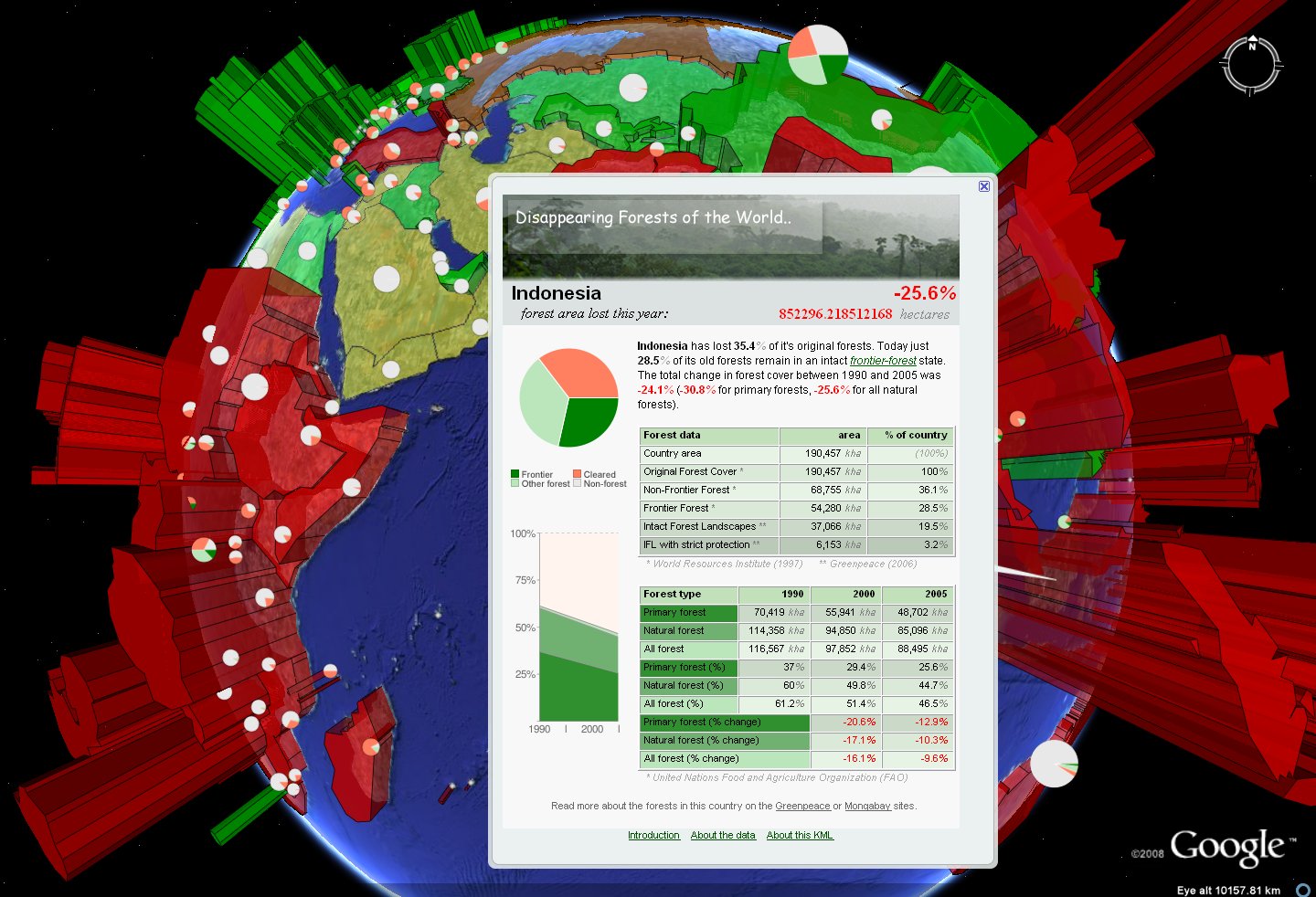
Ref: David Tryse.
He’s got files made up for:
- Disappearing Forests of the World: Shows deforestation data for countries around the world including a live ticker for each country.
- Black Tides: Worst Oil Spills in History: Maps 50 of the worst oil spills (accidental and intentional) from around the globe.
- Edge of Existence: Mammals: 100 of the most endangered mammal species from around the world
- Edge of Existence: Amphibians: 100 of the most endangered amphibian species from around the world
- Survival International: Tribes: Maps 33 indigenous tribes around the globe which are in jeopardy from ranching, logging, mining, and just outright stealing their land.
- Biodiversity Hotspots: 34 locations around the world where great numbers of indigenous species exist no where else–and are at risk of losing their homes.
- National Park Overlays: Maps protected lands around the globe.
The next time you have a presentation to give about any of these green topics, try using these maps on a laptop and projector to dazzle your audience. Graphically, Google Earth is gorgeous–and all the maps are highly interactive.
The best part is that he gives links to all the data resource sites. He’s really done an outstanding job compiling a lot of really valuable, usable information in one place. Go play with it for a while and you’ll be impressed.
So, thanks David Tryse, whoever you are. We’ll be checking back regularly to see what else you’ve got up your organic sleeves.
In order to use this site you’ll need to download Google Earth.
Chicago Green Bridge is a Pathway to the Future
June 18, 2008
Chicago is taking its status as one of the Top 10 Greenest Cities in the U.S. very seriously. While other parts of the country are recovering from the havoc wreaked on their poor infrastructures due to floods, hurricanes and collapsing bridges, The Windy City is looking toward the future with plans to develop one of the premier Eco-landmarks of the new millennium.
The proposed project, still in the planning phase, is a two-mile expanse of bridge that will extend in an arch from Adler Planetarium on the south to East Wacker Drive on the north. The bridge will create a breakwater in the Monroe harbor and provide a civic space for recreational activities, including running and biking, as well as additional protected area for boating and water sports.
Interestingly, the plan is a modern, updated version of the original breakwater proposed in the 1909 city plan of Chicago. The current plan features the construction of wind turbines to line the bridge and create and alternate source of power for the city. The actual breakwater itself will be built on a foundation of slag—a permeable byproduct of steel which will provide a habitat for aquatic wildlife in the lake.
Some critics insist that the project is way over the top. With the $1 billion price tag, and the futuristic high-end design, they feel that it is less about the environment, and more about the city’s 2016 bid to host the Olympics.
There’s no doubt that the project would draw attention to Chicago as a highly desirable tourist destination, which doesn’t necessarily work against eco-initiatives. The bridge’s design is a product of the Chicago based, and world-renowned design firm AS+GG. Adrian Smith, the project’s lead designer was also the lead designer of Trump International Hotel & Tower Chicago, and the Burj Dubai which holds the record as the world’s tallest building. The eco-bridge isn’t just a “home improvement” project for Chicago—it’s a world class structure designed to capture the attention of the world.
The bridge project is not an arbitrary concept that is meant to green wash the city. Chicago has already taken the eco-revolution upon itself in the past decade, with such initiatives as the Green Roof Project, the Green Alley Project, and other steps toward eco-friendly municipal practices that are revolutionary to say the least. For example, since 1989, over 500,000 trees have been planted in Chicago; and the building which houses the Center for Green Technology is one of the only municipal buildings in the world to have received a platinum rating for its green design and operation.
Mayor Richard Daly and his staff make no secret about their plans to define Chicago as the premier city for eco-conscious living in the U.S. Despite its industrial past, the city’s administration and green organizations are on a massive educational campaign that seems to be having just the desired effect. More and more Chicagoans are jumping in the bandwagon, and the city has seen itself transform in leaps and bounds in just a few short years.
Regardless of how beneficial the bridge project advocates claim it is, there is still the tiny little problem of the necessary funding to get the thing underway. Raising $1 billion dollars for a shiny new bridge during a war and a recession may not be the easiest thing to do, and then there is the issue of meeting with the U.S. Army Corps of Engineers who have a say in shoreline redevelopment. There are some obstacles to overcome, but in a social and political environment when many people in this country are still not convinced that there is a need for environmental initiatives of any kind, Chicago will go down in history as one of the leaders who led our country to change during this period of environmental revolution. That in and of itself should be enough to attract forward thinking investors and supporters. After all, who doesn’t want to go down as having supported the winning team from the very beginning?
Enthusiast Fuels his Ecoboat with Human Fat
June 9, 2008
Vehicles that draw their energy from green sources have created an exciting new frontier in the travel industry! At least, that’s what most people think. When it comes to boats, though, alternative energy crafts are nothing new. Back in the day (1902 in fact!), Mary Gordon was an electric-powered boat sporting stained glass windows, silk curtains and luxurious, velvet covered chairs.
So how far have we really come since then?
Pretty damn far.
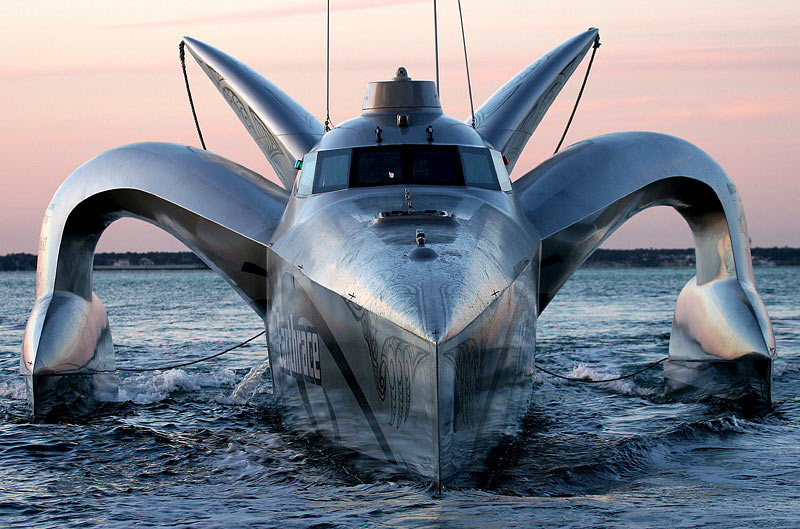
This is Earthrace, a state-of-the-art speedcraft that runs on human fat, in addition to other biodiesel fuels. The crew of this vessel is currently racing to break the world speed record for circumnavigating the globe.
According to the Guardian, Earthrace is a 24 meter powerboat that runs on 100% renewable biodiesel fuels and has a net zero carbon footprint. Furthermore, Earthrace is the first boat in the world to use hemp composite in the construction of the ship body. Lubricants for the ship are made from vegetable oils, bedding foams are made from canola oils, and the crew even eats organic/local foods and wears hemp and bamboo clothing.
Here’s the 70 ft. Mary Gordon–an electric-powered boat–taking a crowd for a tour in 1902. Note how Earthrace appears to be a direct descendant of ‘Ms Gordon’:).
Pete Bethune, the New Zealand skipper of Earthrace, believes the boat can help advance biodiesel as a genuinely viable alternative to petroleum diesel. Bethune and his family are more than a little invested in promoting fuel alternatives-they sold their home and belongings to fund the boat. Demonstrating further commitment to the cause, Bethune underwent liposuction and donated enough of his personal body fat to produce 100ml of biofuel.
Earthrace is now on pace to break the world speed record. The current record holder is British boat Cable and Wireless Adventurer, which circumnavigated the globe in 75 days a decade ago. The race is going well–after a little trouble in paradise, the crew repaired a broken engine and powered into Palau this week, 2400 miles ahead of schedule. Check here to see where Earthrace is right now.
What`s in the future for Earthrace’s technology? Well, the “greenest” part of Earthrace’s design isn’t its two Cummins Mercruiser QSC 540 engines-it’s the unique and incredibly efficient hull.
Unlike other boats that ride on top of waves, Earthrace pierces through them with its trimaran hull. The design allows this boat to go far faster in rough seas than conventional vessels. The piercing is controlled by pumping up to 2.5 tons of water into a special ballast tank in the bow. The faster the boat is travelling, the more it pierces. The limiting speed factor is the crew’s ability to handle the ride, rather than the capacity of the boat. In rough seas, this boat is fierce. If that doesn’t sound like it’s for you, consider a more relaxed alternative such as a solar powered boat.
When not racing or engaged in publicity events, the crew just likes to have fun with their powerful craft. Check them out whooping it up in this wakeboarding video in Loch Ness, Scotland. Watch out, Nessie!
How to Live in a Shipping Container
June 1, 2008
This ain’t your mama’s prefab.
Mobile homes, step aside-shipping containers and other modern techniques and architectures are here.
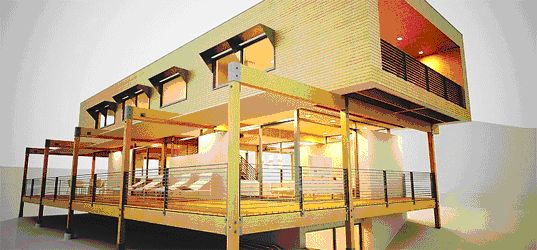
This spring, Brio 54 introduces a new set of prefab residential prototypes. Brio54’s mission is to provide sustainable, affordable design while delivering high quality construction. Each Brio54 home comes complete with green features such as centralized efficient heating and cooling, moisture and ventilation control, dual flush toilets, energy star HVAC and appliances, passive solar energy design, all natural wood and stone flooring, and 3Form Ecoresin countertops.
They have some stiff competition. Since going into production earlier this year, Adam Kalkin has sold a dozen Quik Houses, each based on five shipping containers.
Cheap, strong and easily transportable by boat, truck or train, shipping containers have changed status from waste product to green construction material. The basic Quik House is a two-story, 2,000-square-foot home with three bedrooms, two baths, skylights, and enormous glass windows. The price ranges from $76,000 for the basic kit to $160,000. That`s less than $100 per square foot, including a stainless-steel kitchen and mahogany doors. His most recent design — the “Push Button House” — is a home built inside a shipping container with mechanized walls that open like a blossoming flower.
Architects Pieter Peelings and Silvia Mertens of Sculp(IT) live and work in this four story shipping container home. A spa is located on the roof. Hurricane proof, flood proof, and fire proof, these metal Lego blocks are tough enough to be stacked twelve high. Not only are they green, they fit neatly into odd spaces. Imagine slotting this home in between two skyscrapers!
What`s more, they`re movable. Travelodge recently constructed a “portable” hotel out of recycled shipping containers in London, in anticipation of the 2012 Olympics. Each room is a Travelpod. The containers fit together like a giant Lego set. They can be disassembled and easily reassembled at a different site, or used individually:
The hotel company plans to use Travelpods as an on-site camping alternative for events such as Burning Man. They will be transported from site to site to fit the need for temporary hotels.
Finally, shipping containers work as construction materials in all sorts of environments and difficult-to-reach spaces. These three pictures trace the construction of a home in the midst of a dense rainforest in Australia. This double container home is accessible only by a narrow, unpaved path. The PVC pillars keep the house dry, stable, and vermin-free without disturbing the complex root system underneath. The materials cost less than $16,000 and are both recycled (for the most part) and recyclable for the future.


Comments