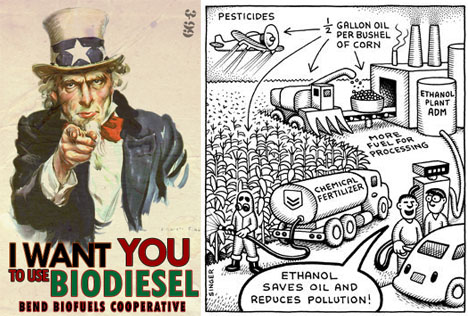
7 Clever-but-Questionable Eco-Power Innovations
February 25, 2008
It is all too easy to get excited about the next big sustainable technology for saving energy or producing non-polluting power – and forget the flaws in many of these ideas. Some of the best projects show smart out-of-the-box thinking but lack feasibility or, in some cases, might do more harm than good. While these ideas may not work at least scientists, politicians and other innovators are beginning to explore alternatives.
The World’s Biggest ‘Environment’: The Water
February 16, 2008

It is no surprise that as land-dwellers we don’t think about the oceans as much as we should given that they cover over 2/3 of the planet. The water bodies of the world may be the key to progress for our species in more ways than one (such as underwater living shown above) and the oceans hold many mysteries yet to be discovered. Still, we are having a profound effect on our waters and need to be mindful of just how powerful our impact can be.
Amsterdam is perhaps a likely place to find proposed innovations in underwater living – a progressive place that continues to face challenges related to rising water levels. Why under the canals specifically? They can be drained, dug down and built into and then simply refilled – there would be no need to uproot existing dwellings to proceed with this process.
A mysterious compound known as chromophoric dissolved organic matter (CDOM) may be a key piece in the puzzle of ocean life. This material is thought to be vitally linked to the development and nature of ocean life as well as greenhouse gases and climate changed. This matter is simply the combined refuse from various plants and other debris that mix in the world’s oceans.
“Almost half of the world’s oceans have been seriously affected by over-fishing, pollution and climate change, according to a major study of man’s impact on marine life.” An alarming study shows that as much as 40% of marine life has been “significantly altered” by mankind while only 4% remains essentially untouched.
How About a Paperless Home?
February 10, 2008

Except perhaps in the bathroom, do you really need any kind of paper? These days it seems like paper is just an intermediate step or default conclusion – a copy that will eventually be scanned in or a digitally written paper printed out at the end. Still, is paperless the solution to environmental problems or simply wasteful in another way?

Some families are choosing to go entirely paperless though this choice isn’t necessarily a complete fix for the environment: paperless lists, games, educational tools and other devices still require energy to run. Also, with the virtually unlimited supply of information online and in digital form many people don’t think twice about printing out a copy for temporary use and then discarding it.

Also, while paper use is decreasing in many developed countries there are many places in the world where paper use is still on the rise, such as China and South America. Hopefully as paperless approaches become more the norm at work and at home energy efficiency can be increased and the world will begin to adjust to the new technologies without needing to print out unnecessary hard copies.
More at TreeHugger and the New York Times
The Unsustainable Church of Scientology
February 6, 2008
Many would say that the Church of Scientology is unsustainable in more ways than one, but few have stopped to consider how that applies to the natural environment. While Scientologists overtly organize to protect nature and profess to protect the planet many of their practices seem to contradict their statements. The overall effect seems to be alarmism couple with inaction: all of the theoretical zest of GreenPeace with all of the inaction of President Bush. Here are some of the ways in which Scientology seems to skew environmental issues and play on public opinion without a correspondingly set of proactive strategies. This side of Scientology seems to have been lost in the scandalous shuffle of recent news but Scientology’s mixed messages and actions on the environment are also important.

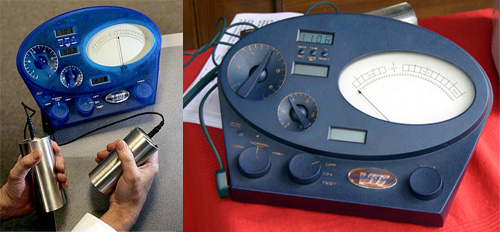
Strange Science: Putting aside questions of science versus pseudoscience, dsagree or agree with climate change, the infamous Hubbard Electrometer is purported to measure mysterious “environmental toxins” in one’s bloodstream. This “technology” is misleading at best as well as a waste of resources, from the mechanical components in these myriad devices to the endless pages of paper wasted while producing “diagnoses” of individuals. Perhaps worst of all this strange emphasis on mysterious environmental factors distracts from actual environmental issues.

Global Apocalypse: Still, the E-Meter isn’t their only environmental concern – Scientology is also worried about the future of the planet. Still, if Scientologists are truly concerned with saving the Earth, which in their words may “no longer support life [within our] lifetime,” then why focus on graffiti removal and other short-term city beautification projects? Were this global apocalypse truly a concern for them it would seem that their priorities don’t align with their concerns about the world. Why worry the small things if the entire planet is at stake?

Mixed Recycling: Recycling is in fact an overt priority for Scientology in theory which appears to go unfulfilled in actuality. One of their own organizational loci, the Flag Service Organization, completely fails to recycle even basic soda cans. Moreover, the Church of Scientology prints its pamphlets, magazines and fliers on glossy, heavy, non-environmentally friendly paper before sending them around the world to likely wind up littering streets and tossed into garbage cans. No, they aren’t evil for failing to recycle, but it seems incongruent to publicly advocate recycling and clean living but not to recycle in-house.

What Does it All Mean? Sure, the Church of Scientology puts on a great show for the public. They are active in local settings picking up trash, cleaning up parks and removing graffiti – all things that others outside the organization can see, appreciate and identify with. But one has to wonder if that’s not precisely the point: are they perhaps just focusing on the most obvious sustainable actions for the purposes of improving public perception of the organization and recruiting new individuals to it? Environmentally speaking they are perhaps at best stuck in a previous generation’s thought patterns, when it was believed that little things made the big differences in the end, or at worst just putting on a good show.
New Mammal Discovered, Others Still Suffer
February 4, 2008

It is an unfortunate fact of modern life that most species-related news is negative these days. We read about habitats disappearing, animals going extinct and other tragedies. When a positive story does come along it is therefore all the more inspiring.
A new species of mammal has been discovered in the mountains of Tanzania, scientists report. The bizarre-looking creature, dubbed Rhynochocyon udzungwensis, is a type of giant elephant shrew, or sengi. The cat-sized animal, which is reported in the Journal of Zoology, looks like a cross between a miniature antelope and a small anteater. It has a grey face, a long, flexible snout, a bulky, amber body, a jet-black rump and it stands on spindly legs. via BBC News
As with so many species being lost today this new mammal was discovered in Africa. Hopefully such inspirational events can serve a positive purpose and remind people around the world that there are many species yet to be found, many of which could be lost forever if something isn’t done to protect their environments.


Comments