Environmental Images


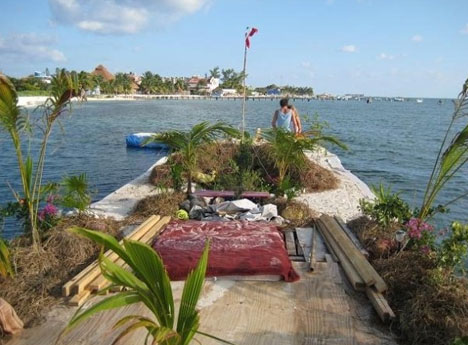
The original Spiral Island was the talk of the world: a man-made floating island constructed from 250,000 plastic bottles that could drift and relocate as needed until it was destroyed by disaster. Now the new Spiral Island is slated to open to the public within the next few months in Laguna Makax near Isla Mujeres. The new island has drawn in donations, volunteers and visitors from all parts of the world and walks of life - people inspired by what may be one of the most impressive do-it-yourself projects of modern times.

(Above: the old Spiral Island, Below: The new one under construction)

The infamous island has been at the center of controversies with each step forward as any endeavor this industrious and unusual is likely to be. Some claim it is a brilliant environmental design - using almost exclusively recycled materials in its construction. Others note that when the last island was destroyed it resulted in the littering of its materials and is in many ways the work of a single insane architectural genius. Still, were it not for that catastrophe those materials would still be providing a home for some and destination for others with a minimal use of non-recycled parts and clearly its creators never intended for it to be demolished in such a fashion.

There is a variety of media available to people who want to learn more about spiral island. The Spiral Islanders site has forums, a blog, photo collections and videos related to the construction and history of the island as well as the stories and experiences of those who have worked on it and the areas in which they have done so. It is easy to see how, as people learn more and more about the project, they become increasingly intrigued and many ultimately end up visiting and helping with the island itself. The Ripley’s Believe-It-Or-Not video below and photo collection are also a great place to get a feel for the island.


Find more photos like this on Richie Sowa's Spiral Island

Rare New Mammal Species Discovered

It is an unfortunate fact of modern life that most species-related news is negative these days. We read about habitats disappearing, animals going extinct and other tragedies. When a positive story does come along it is therefore all the more inspiring.

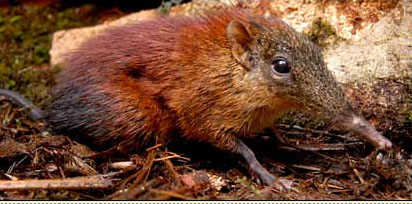
A new species of mammal has been discovered in the mountains of Tanzania, scientists report. The bizarre-looking creature, dubbed Rhynochocyon udzungwensis, is a type of giant elephant shrew, or sengi. The cat-sized animal, which is reported in the Journal of Zoology, looks like a cross between a miniature antelope and a small anteater. It has a grey face, a long, flexible snout, a bulky, amber body, a jet-black rump and it stands on spindly legs. via BBC News

As with so many species being lost today this new mammal was discovered in Africa.  Hopefully such inspirational events can serve a positive purpose and remind people around the world that there are many species yet to be found, many of which could be lost forever if something isn’t done to protect their environments.

Drivable Human Powered Car

They’ve talked about it, they’ve made prototypes and now finally here it is: a human-powered car (The HumanCar) that can reach speeds of up to 80 miles per hour. Beyond just sounding like one, this invention bears an uncanny resemblance to the walkable vehicle from the Flintstones. Love it, hate it, mock it or berate it this strange new vehicle is available for $15,000 as of Earth Day 2008!

Sketches and Mockups of the Human Powered Vehicle

The human car isn’t just about energy efficiency or the environment, it is about group activity - making driving an actively participatory experience. It is also about alternative uses for a vast global infrastructure designed and used almost exclusively by gas-guzzling vehicles. The idea for the car has been around for almost five decades now but prototype models only began being built and seriously tested a few years back.

Wireframe Rendering of Human Powered Vehicle

As compared to the bicycle, the HumanCar provides greater speeds and an impact-resistant exoskeleton provides material safety and shelter from the weather. Also, power-assist from batteries can boost the car’s performance in a pinch and help it keep up with regular vehicles on the streets and the built-in trunk, stereo and wi-fi blend in options people have come to expect from cars.


The above video dates back to early models of the car. Try to ignore the music and simply enjoy the ride. The makes say those who try it out keep coming back for more!

sanyo_solar_ark.jpg

Sanyo in Japan has constructed an amazing solar-collecting building that embodies both clean-energy ideals and awesome architectural design strategies. The so-called Solar Ark has over 5,000 active solar panels generating over 500,000 KWh of environmentally friendly energy. Nearly 500 multi-colored lighting units placed between the various solar panels can be activated to create a variety of shapes and letters on the sides of this enormous structure.

solar_ark_sanyo.jpg

area_e.gif

As a working example of the potential of solar energy, the structure contains a solar museum with interactive exhibits as well as a solar lab and various meeting rooms for global environmental programs. The curved form is designed to take maximum benefit from as well as to graphically reflect the path of the sun and its energy. An elaborate truss system allows dizzying cantelevers to span out from the center of the structure and rise toward the sky. More info @ MetaEfficient.

solar_ark.jpg

solarark.jpg

giant-catfish.jpg

Captured just before midnight on November 13 by fishers in Cambodia, this Mekong giant catfish is 8 feet long (2.4 meters long) ands weighs 450 pounds (204 kilograms).

Kinky Apes Get Protection: The bonobo ape has rather prolific mating habits. The kinky apes are one of human beings’ two closest relatives and officials in the Congo have announced the creation of a massive rainforest preserve intended to protect them.

Can Chocolate Save the Environment? A rather unique solution to rainforest preservation through the introduction of Cocoa trees that shows that many Latin Americans are taking tropical deforestation seriously… and doing something about it! Excellent article.

Cleaning Up Oil Spills with Hair and Mushrooms? The recent Cosco Busan oil spill in the San Francisco Bay may have just met its match in an eco-cleaning solution that uses human hair and mushrooms! A group of intrepid volunteers has embarked on a project to clean up oil at San Francisco’s beaches using an unusual, yet totally organic, method of waste removal:

Next Page »