21st Century Flintstone’s Car Finally for Sale
January 29, 2008

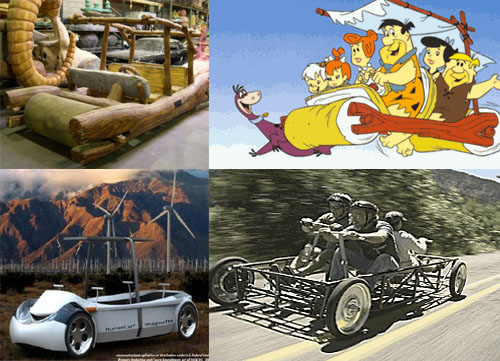
They’ve talked about it, they’ve made prototypes and now finally here it is: a human-powered car (The HumanCar) that can reach speeds of up to 80 miles per hour. Beyond just sounding like one, this invention bears an uncanny resemblance to the walkable vehicle from the Flintstones. Love it, hate it, mock it or berate it this strange new vehicle is available for $15,000 as of Earth Day 2008!

The human car isn’t just about energy efficiency or the environment, it is about group activity – making driving an actively participatory experience. It is also about alternative uses for a vast global infrastructure designed and used almost exclusively by gas-guzzling vehicles. The idea for the car has been around for almost five decades now but prototype models only began being built and seriously tested a few years back.

As compared to the bicycle, the HumanCar provides greater speeds and an impact-resistant exoskeleton provides material safety and shelter from the weather. Also, power-assist from batteries can boost the car’s performance in a pinch and help it keep up with regular vehicles on the streets and the built-in trunk, stereo and wi-fi blend in options people have come to expect from cars.
The above video dates back to early models of the car. Try to ignore the music and simply enjoy the ride. The makes say those who try it out keep coming back for more!
What is it About Climate Change?
January 24, 2008

What is it about climate change that stirs everyone up so much? When innovative technology is applied to cars, houses or other everyday things everyone seems to celebrate progress. However, when articles come out about climate change the tone shifts and the skeptics come out in force. Ecoble invariably gets the most crass, spammy and downright incorrect comments on such articles. But why?
Is it just too big of a concept for people to grasp? Too complex to know for sure and therefore it elicits negativity? Or could it be that we are scared it could be true and eager to believe detractors who, possibly for personal profit, resist reacting to the potential threat post by global climate change? Even when alternative explanations, such as volcanoes, are presented to problems such as localized ice melting.
In the face of the complex and (of course) global nature of the problem, it is all too easy to throw up one’s hands and declare there’s no point worrying about it. But there is. Climate change could have a series and devastating impact one the world, affecting humans in every aspect of life from temperature to agricultural production. The debate just keeps heating up, too, as private individuals, companies and entire industries on both sides find they may have a lot to lose.
If you’re still a doubter after combing recent related news articles, look no further than this description of what may be the sixth mass extinction on Earth. Is it alarmest? Maybe. Are species becoming extinct at a more rapid rate than at any other point in human history? Absolutely. What does it mean? That’s up to you.
5 Strange Stop-Gap “Solutions” to Climate Problems
January 17, 2008

Wait so is it global warming, cooling or climate change? Good, bad or ugly? The questions, perspectives and believes about climate issues change almost as much as the proposed solutions or interventions. Some of these supposed answers to core climate questions are truly as bizarre as these weird alternative fuel sources and outlandish as this incredible man-made recycled island. Whatever your opinions on climate change these are, at the very least, entertaining and extremely odd.

A volcanic eruption is a bad thing … right? Well, according to some scientists: not necessarily. The theory goes something like this: a faked volcanic eruption (via rockets shot nearly into space) could disperse sulphur into the upper atmosphere and block incoming and outgoing radiation. Of course, this plan has its critics. Other scientists worry about potential drought and other unforeseen consequences of such a bold and brazen act of geoengineering. And how could the process be undone if needed?

The idea of wrapping entire glaciers with sheets seems a bit far fetched and fanciful yet some scientists have proposed we do just that to prevent their rapid melting. One company has even developed the means to do it: a material dubbed Ice Protector that, in giant swathes, would be used to surround and protect glaciers. In tests the material was able to deflect heat and keep in the cold. Still, at $12 million per square mile this clever idea might not really be an affordable one.

Who ever heard of genetically engineering trees to be more shiny? Well, in a world with square watermelons probably pretty much anything is possible. Such shiny trees are one proposes way to cut down heat absorption on Earth and deflect more of the sun’s rays back into space. A bit quirky? Sure. That much beyond what is already being done to modify our plants and food supply? Probably not.

We always hear that if everyone contributed to a project they can make a world of change. Well, according to scientists, one simple measure – painting all our roofs white – could do just that. Not that it is likely to happen, but scientists believe that if everyone in the world painted their roof white the global temperature would drop to the level it was at a hundred years ago. Again, though, this is just a way to buy time to find other solutions, but it is still something to ponder the next time you re-roof your house!

So, heat is the problem, right? What if we could block a significant part of the sun’s rays entirely? How about 55,000 orbital mirrors to take on that task? That move alone would reduce the increasing levels of carbon dioxide on Earth by half. Of course, these mirrors would each be over 50 square miles in size and they are beyond expensive. Still, just imagine what it would look like to see these new ’stars’ in space! If you’re not sure where you fall on the questions (let alone answers) on the climate change issue, you may want getting this guide to the politics and science of the climate change debate. And for more green stuff, check out this sweet green art and this unusually green vehicles.
What Does it Mean When Vehicles Go Green?
January 15, 2008

When it comes to vehicles, green can mean many things. Many supposedly environmentally friendly vehicles also aren’t as green as people might assume at first glance. These three articles provide some facts, figures and humorous anecdotes about what it really means to go green.
Everything You Know about Green Cars is Wrong: Much of what you think you know about “clean cars” is wrong, misinformation spread by word of mouth and unreliable blogs (not including this one). Here are some of the prime misconceptions, with corrections applied:
More On Coskata’s $1 per Gallon Ethanol: The Coskata process that GM is promoting can use a wide range of different feedstocks to produce ethanol. Materials ranging from agricultural waste to purpose grown crops that can be raised on marginal lands (switchgrass being the most widely known example of this) to waste materials such as old tires and even municipal waste streams can all be used as the raw materials that can be turned into ethanol with very little to zero landfill waste.
Top 5 Unusually Green Vehicles of 2007: As demand for environmental alternatives grows, some green-thinking automotive designers have gone above and beyond simple hybrid or energy-efficient cars to develop radically creative green vehicles in many senses of the word. Here are five of the most interesting, innovative, strange and downright bizarre green concept vehicles developed this past year.
How Can You Question Climate Change Now?
January 11, 2008

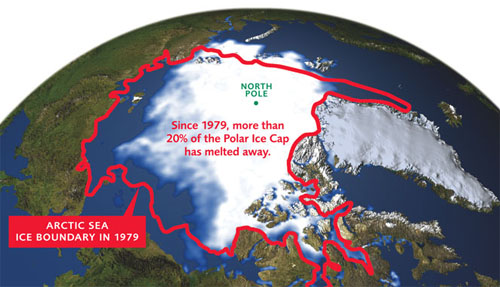
So a lot of people question the mechanism, cause or even existence of what is now commonly called climate change. Sometimes they call out the words ‘global warming’ and then point out that there is cooling going on as well in the world. Well, details and titles aside you can’t argue with melting ice caps, can you? Nature may have its cycles but this is unquestionably unusual and incredibly significant to the global climate.
Ominous Arctic Melts Worry Experts: An already relentless melting of the Arctic greatly accelerated this summer, a warning sign that some scientists worry could mean global warming has passed an ominous tipping point. One even speculated that summer sea ice would be gone in five years.
Why Isn’t Antarctica Melting? Antarctic sea ice hasn’t shown the same obvious melting patterns in recent decades as the Arctic, fueling the global warming denialist crowd. Though the data isn’t as consistent as in the North, where the extent of sea ice this summer hit a stunning record low, southern sea ice has been expanding.


Comments