Solar Power


Want to green your ride, but can’t afford a Tesla? That’s okay… there are plenty of cool (if not quite so flashy) new transportation options coming down the pike that will cost you less than $100,000. Some of ‘em you can even build yourself.

Seriously Strange Fossil Fuelings:

Who needs hydrogen? Some energy alternatives have been around for years, and are making a comeback.

1. Wood

It’s not talked about as much as the Manhattan Project, but there was a big energy crisis during WWII, when the military sucked up a huge portion of the world’s petroleum output. Individual car-owners across Europe converted their cars and trucks to run on… wood.car_wood_truck051008_1a.jpg

Wood?

Wood. Engines don’t run on liquid gasoline - they literally run on fumes. Same goes for the fire in your fireplace – when you see flames rising, that’s the fumes of volatiles coming off the logs and igniting. You can do the same thing in your car.

Some folks are working on making this high-tech, with scrubbers and sealed, carefully controlled burners. Renewable Energy Systems are currently running a demonstration coast-to-coast tour with a couple of modded 1991 Dodge Dakota V8 pickups.

But for now you can go very low-tech – plonk a stove on the back of your pickup and run a vacuum hose to the carburetor; after that your spark plugs ignite the fumes as per usual. You can get information on the web to rig your vehicle with a hundred or so dollars in parts: Jim Mason offers workshops and info, or order a how-to guide from Mother Earth News.

But either way, your fuel can be wood if you want – or any scrap biomass.

2. Steam

british_steam_car.jpg

The British Steam Car looks like the Batmobile and runs like an iron horse. It is not quite road-ready just yet, though, as it guzzles 1,000 litres (one ton!) of water per 25 minutes of travel time. So for now it is recommended only for shorter commutes (or perhaps not at all).

3. People Power

car_humancar.gif

HumanCar is driven by people - even the steering is human powered, like on a bicycle or motorcycle.

How does it work? They’re being very, very cagey – there’s lot of talk on their website about patents and proprietary trade secrets, not too much on how it will run.

But for sure, this won’t be a Flintstones-style feet-through-the-floor operation.

Already on the Market:

4. ZAP Xebra

car_zap_xebra.jpg

Perfect for in-city commuting or shopping, this little car only has a 25-mile range. Still, it brags that even after counting emissions from generating the electricity it uses, it produces 98% less pollution than a gas vehicle. And it’s available now. Next up: A ZAP trucklet with a solar panel to fuel itself.

5. Smart Fortwo

car_Smart_Fortwo_On_Street.jpg

This may look like a toy, but it pumps out 110 horsepower (between a 4-cylinder gas engine and a 50-kilowatt electric motor) And it is kind of cute. This vehicle seats two comfortably (depending on the individual, of course); at a stretch you can cram in thirteen contortionists.

Future Green Transport:

6. Zoop

car_zoopcar.jpg

This little electric flitter can travel at up to 120 mph (although that prospect raises the specter of “Unsafe at Any Speed”). The Zoop is more about being seen – hence the clear canopy and the flashy design by EV-proponents André and Coqueline Courrèges of Paris-based fashion house Maison de Courrèges.

7. Ecooter

car_ecooter_side.png

It is hard to say whether this Chinese offering is even a car, and even the name implies it is some sort of scooter…

Still, it has four wheels (in a diamond layout, rather than the standard “four corners” formation) and there is a roof over your head to keep out the wind and rain, so perhaps it qualifies.

The way it parks is particularly interesting - thanks to the diamond wheelbase, you can do some remarkably tight turning with this little thing:

YouTube Preview Image

7. Loremo

car_loremo.jpg

The name stands for “Low Resistance Mobile” This just goes to show that you don’t need to wait for next decade’s technology to accomplish amazing things with milage: The Loremo combines a highly-efficient German-engineered diesel engine with extremely low-drag design to achieve 150 miles per gallon. Coming next year to Europe, with US launch to follow.

8. Helios

car_helios_99dty_69.jpg

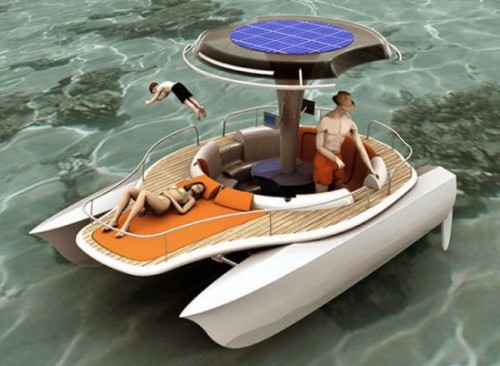
Want to really get off the grid? Helios has the answer: a solar-powered buggy with a saurian solar sail that spreads out to soak up the sun and recharge, photovoltaicly. This concept car won the Best Use of Technology at the Interior Motives Design Awards 2008. Note to racers: do NOT attempt to deploy the sail as a drag chute…

9. The Air Car

car_airpod.jpg

Coming as early as spring 2009 from MDI and Zero Pollution Motors, it runs on compressed air. Developed by Formula One engineer Guy Nègre, the Air Car is expected to make big inroads in India, where it will be sold as the Tata Nano for $2500.

10. VW 1-Liter

Car_VW_one_liter_car.jpg

A few of the mainline automakers are trying to break out of the gas-guzzler mode (although not GM, who have announced they won’t be bringing their min-cars to the US market, further demonstrating their brilliant business acumen and why the government should give them a big bailout.) VW wanted a car that would go 100 miles on one liter of gas, but it’s taken them more than six years to perfect the high-tech low-weight materials like carbon fiber and titanium. Along with a super-sleek aerodynamic shell, this diesel-powered commuter car is scheduled to get a spectacular 235 mpg when it hits the roads (in a limited edition test release) in 2010.

Can’t wait - or really want to do something now? Don’t despair - you can upgrade your current rustbucket to at least make it a little more fuel-efficient.

[3] Comments -->

The US Airways Center will be the latest venue to benefit from alternative power, as the Phoenix Suns have announced plans to utilize solar panels, one of only a few professional sports organizations to currently do so.

Enough energy will be provided from the panels to reduce energy usage by roughly 26 home games, says Suns General Manager Steve Kerr. In other words, it will be as if 26 Suns basketball games never occurred at the US Airways Center, which means a big improvement on power consumption. Also, 440,000 pounds of carbon dioxide are expected to be eliminated each year. A total of 1,100 panels at 194 kilowatts on the parking garage’s fifth level will make this feat possible, providing a green mentality that celebrated Canadian and Suns point guard Steve Nash can get behind. Nash has long been a big proponent for eco-friendly sports venues  and green initiatives as a whole, so the star should be pleased with his team’s efforts, which are likely to be expanded to include the use of green cleaning products by the maintenance crew, and more. Nash is even apparently installing solar panels at his home - perhaps we should call him Apollo Nash?

The new installation will run the Suns about $1.5 million, but the Arizona Public Service Co. will rebate the team $60,000 to $85,000 each year as part of their commendable renewable energy incentive program. However, the Suns won’t be ponying up cash themselves any time soon, and fans won’t be seeing an increase in ticket prices, concession costs or anything similar to make up the difference. Instead, the organization is teaming up with Tioga Energy, who will conduct panel maintenance for the next 20 years in return for an annual fee paid by the Suns that is contingent on the amount of solar energy produced.

All in all, it seems like a win-win situation for both parties as well as the environment. And hey, doesn’t it all just make sense for the Phoenix Suns? Surely there can be some additional beneficial publicity arising from this, too, given the team name.

For the record, the Suns aren’t the first to get in on the eco-friendly action. The San Francisco Giants were the first baseball team to use solar power, installing 590 panels at AT&T park back in March 2007. The Boston Red Sox and Colorado Rockies have followed suit since, at Fenway Park and Coors Field, respectively. In August of this year, it was announced that the Staples Center, which houses the Los Angeles Lakers, would receive their own collection of 1,700 solar panels.

Source: azcentral.com

No Comments -->

Author’s note:
It is beyond the scope and space available in this blog to fully explain how important solar energy has always been.  For this reason, much of the information here is meant to be a LINK to other information, and is connected to it through hyperlinks to other web pages.  To better understand how important solar energy is, it is strongly advised that you click on some or all of these links.  Each one will open a new window, so you will be able to return easily to this article, and continue along the train of thought it offers.  — Roger

Deep field image of many galaxies. Courtesy of NASA
Solar energy is the most abundant form of power in the universe.  By definition, every solar system contains at least one colossal generator of raw energy.  Galaxies are composed of millions or even billions of solar power plants, and there is no known form of life that does not depend on it, either directly or indirectly.  The very air we breathe is a byproduct of solar energy acting upon the planet.  Even nocturnal plants and animals, which can’t bear to be exposed to direct sunlight, couldn’t exist without solar energy.  Even most things which are poisoned by direct solar energy depend on it to fuel their growth, or provide their food.  For humanity, solar energy is not just a viable choice, it has been the only option all along.

Without sunlight, there could be no fields of grain. Image courtesy of photobucket

Primitive man discovered this truth.  He learned that crops had to have enough sunlight to grow tall and strong, and produce the largest crops.  He discovered that plants demanded sunlight, and converted it into grains and grasses, fruit and foliage, vegetables and vineyards, and from these things came everything else he needed to live and prosper.  Longer days had warm sun rays, and the shortest one was found in the dead of winter.  In many ways, primitive man knew more than most of us alive today, even though he lacked the wisdom to tie the links together, or the ability to record his findings for posterity.

But this is nothing new.  We all learned the basic truth of all existence in grade school, and most of us promptly left that knowledge in the same crowded classrooms.  We graduated from our educations, and moved into our 5 day work weeks with 9-5 jobs, and never again questioned why the modern world, with its abundant electricity, is still tied to a pattern of activity in the light, and dormancy in the dark of night.  For most of us, the sun is little more than a consequence of existence, and very few acknowledge why it is the gods of the light that rank highest among the dieties of myth and legend.

Many think of the sun in connection with beaches and fun. Images courtesy of Flickr

As a child in the 1970’s, I heard the first rumors of global warming, and learned such novel terms as ecosystem and food chain.  And I wondered, even then, how something as huge as a burning star could be overlooked as the most feasible way to live in harmony.  I can’t recall the times I’ve tried to patiently exlain the chain of events the sun makes possible for us, and it is difficult to relate the blank, bored stare of those I tried to convince.  Thirty-odd years later, and global warming has turned our only recourse into a demon, and those who think of the sun do so with a bottle of sunscreen in hand, and either excitement or a faint inflection of resentment in their tone.  And no one seems to be able to comprehend that the sun, instead of being our enemy, is the only real source of power we have ever had.

The sun is setting on oil fields - Photo from Flickr

Without the sun, there could be no fossil fuels.  Our seasons would have long since blended into a frozen, lifeless period of perpetual darkness, and the complex chemical reactions that form natrual gases would have stalled, frozen on a wasteland of ice colder than dry ice, and just as inhospitable.

The Sun Face is a common image on native american totems. Image courtesy of Flickr

Today, I hear again and again how solar energy is not an affordable solution to the world’s problems.  And I bear the uncomprehending glare of those who are simply unable to see that we can’t afford not to use the sun.  No matter how basic the connection is, humanity seems unwilling to recognize that there isn’t another way, that there has never been another way, and that no matter how far through the cosmos we will ever go, everything we will encounter is either a product or source of solar energy, whether it be hydrogen fuel, biofuels, or the fuels which form nuclear reactions.  Not even the wind that blows through the trees would exist without the power of sunlight.  Take a cue from the totem poles and mythological dieties of ancient times, and recognize the sun for what it truly is - the only true source of energy mankind will ever know.

No Comments -->